Rate Models & Yield
The Interest Mechanism
$M token operates within a balanced interest system in the M0 Protocol:
- Minter Interest Accrual: Minters accrue obligations at the minter rate on their outstanding
$Mbalances. - Earner Interest Accrual: Simultaneously, approved earning accounts accrue additional tokens at the earner rate.
- Rate Synchronization: The EarnerRateModel ensures the earner rate is calibrated so total earnings never exceed total minter obligations (see Rate Model section below for further details).
- Continuous Mechanism: Both sides update through independent but synchronized continuous indexing systems.
This creates a mathematically balanced system where earner yields are safely constrained by the protocol's income from minters.
$M token implements sophisticated interest rate models that ensure financial soundness while distributing yield between
minters, earners, and the protocol.
Rate Model Architecture
The protocol uses two primary rate models:
- MinterRateModel: Determines the interest rate minters pay on borrowed
$Mtoken- Simple model that reads rates directly from the TTG Registrar
- Capped at 400% APR (40,000 basis points) for system safety
- Governance-controlled through the
base_minter_rateparameter
- EarnerRateModel: Calculates the interest rate paid to
$Mtoken holders who opt in to earning- Uses a mathematical formula that ensures financial soundness
- Rates are capped at 98% of the calculated safe rate
- Governed through the
max_earner_rateparameter
Minter Rate Calculation
The MinterRateModel has a straightforward implementation:
function rate() external view returns (uint256) {
    return min(TTGRegistrar.get("base_minter_rate"), MAX_MINTER_RATE);
}
- The rate is governance-controlled through the TTG Registrar
- Has a hard cap of 400% APR to prevent system abuse
- Changes to this rate affect all minters uniformly
Earner Rate Calculation
The EarnerRateModel employs a more complex approach to ensure system solvency:
function rate() external view returns (uint256) {
    return min(
        maxRate(),
        getExtraSafeEarnerRate(
            totalActiveOwedM,
            totalEarningSupply,
            minterRate
        )
    );
}
Where:
getExtraSafeEarnerRateapplies the rate multiplier to the safe earner rateRATE_MULTIPLIERis 9,800 (98% in basis points)ONEis 10,000 (100% in basis points)maxRate()returns the governance-set maximum earner rate
Safe Rate Derivation
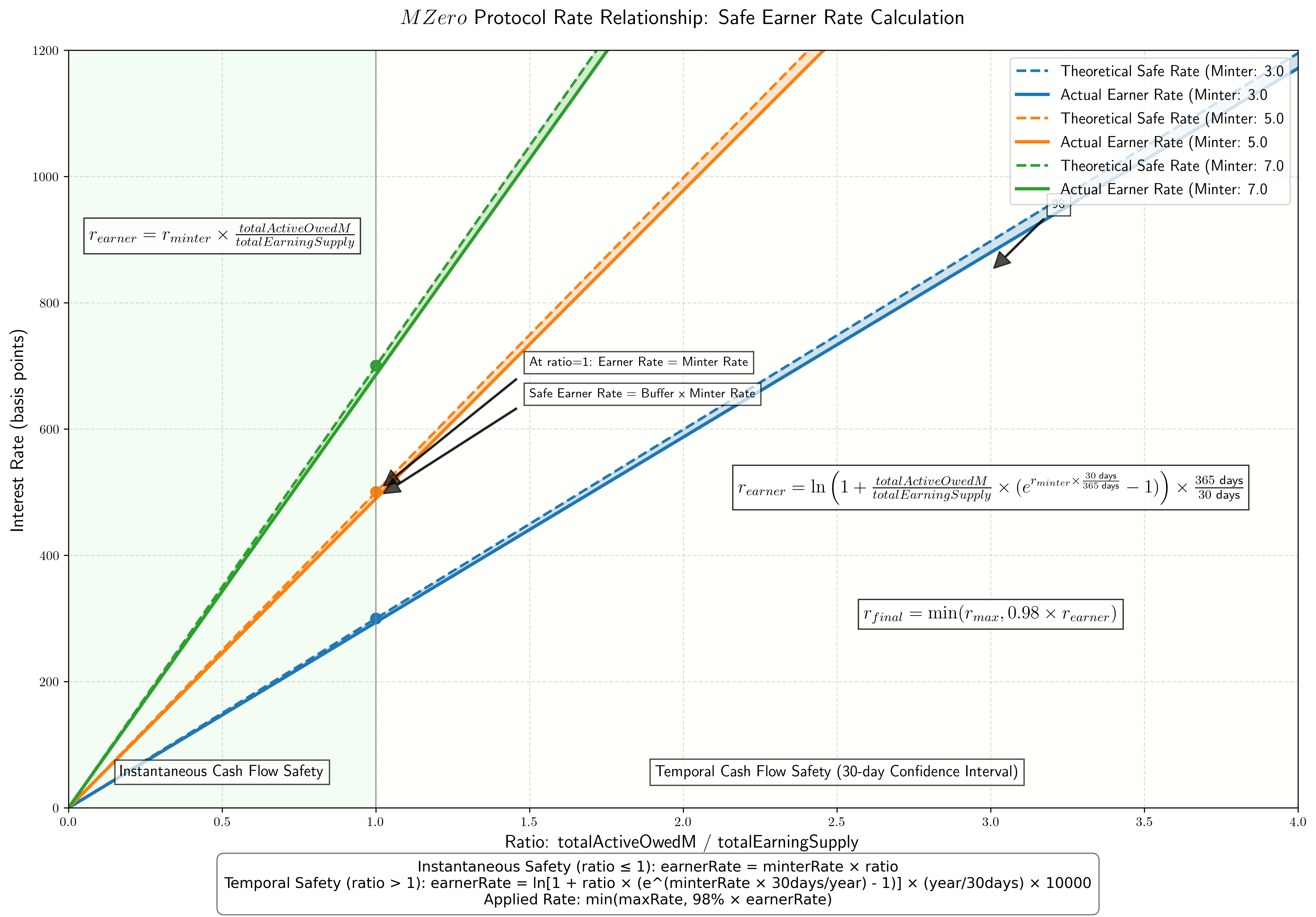
The safe earner rate is calculated using two different approaches based on the relationship between total active owed $M and total earning supply:
- When totalActiveOwedM ≤ totalEarningSupply:
- Uses an instantaneous cashflow approach
safeRate = totalActiveOwedM * minterRate / totalEarningSupply- Ensures interest paid to earners never exceeds interest collected from minters
- When totalActiveOwedM > totalEarningSupply:
- Uses a time-integrated approach over a 30-day confidence interval
- Accounts for compound interest effects
- Applies complex mathematical formula to ensure long-term solvency
- Allows earner rate to temporarily exceed minter rate while maintaining system safety
Extra Safety Factor
The EarnerRateModel applies an additional safety factor to the calculated safe rate:
function getExtraSafeEarnerRate(
    uint240 totalActiveOwedM_,
    uint240 totalEarningSupply_,
    uint32 minterRate_
) public pure returns (uint32) {
    uint256 safeEarnerRate_ = getSafeEarnerRate(totalActiveOwedM_, totalEarningSupply_, minterRate_);
    uint256 extraSafeEarnerRate_ = (safeEarnerRate_ * RATE_MULTIPLIER) / ONE;

    return (extraSafeEarnerRate_ > type(uint32).max) ? type(uint32).max : uint32(extraSafeEarnerRate_);
}
This ensures that earners receive 98% of the theoretically safe rate, creating an additional buffer for protocol safety.
Confidence Interval Approach
The EarnerRateModel uses a 30-day confidence interval to determine safe rates:
- Calculates the amount of interest minters will generate over 30 days
- Derives maximum earner rate that ensures total interest paid doesn't exceed this amount
- Accounts for the compounding effects of continuous interest
- Assumes the
updateIndex()function will be called at least once every 30 days
Balance Between Minters and Earners
The system maintains a mathematical relationship between interest flows:
totalInterestFromMinters = totalActiveOwedM * (e^(minterRate*dt) - 1)
totalInterestToEarners = totalEarningSupply * (e^(earnerRate*dt) - 1)
The rate models ensure: totalInterestToEarners ≤ 98% of totalInterestFromMinters
Edge Cases Handling
The EarnerRateModel handles several edge cases with special logic:
- When
totalActiveOwedM = 0orminterRate = 0: The earner rate is set to 0 - When
totalEarningSupply = 0: The earner rate is set to the maximum possible value (type(uint32).max) - When calculations might overflow: The implementation includes safeguards against numerical issues
Yield Distribution
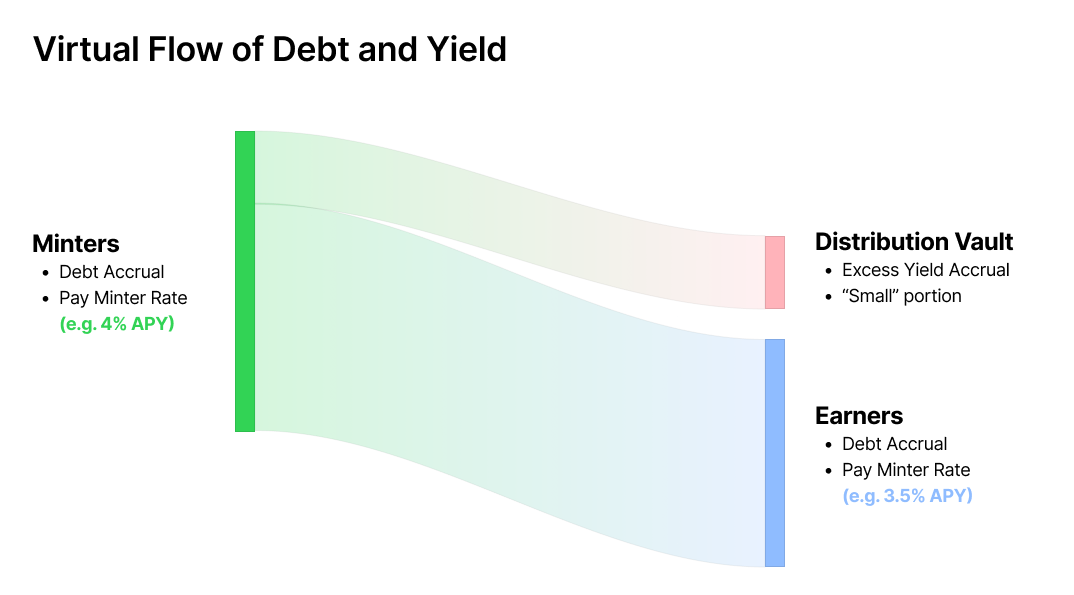
The system distributes yield in the following manner:
- Minters pay interest based on their outstanding debt at the minter rate
- Earners receive up to 98% of the available interest (subject to constraints)
- Excess yield (at least 2% plus any additional buffer) goes to the TTG Vault
- The TTG Vault funds protocol operations and can distribute to governance token holders
Rate Update Mechanism
Interest rates don't change automatically when governance parameters are updated:
- Rate changes in the TTG Registrar take effect only when
updateIndex()is called - Both
$Mtoken and MinterGateway must update their respective indices - Updates occur automatically during key operations such as minting, burning, and transfers
- Rate models recalculate rates during each update based on current system state
Mathematical Precision
The implementation includes several technical considerations:
- Rates are stored in basis points (1/100 of a percent) for precision
- Calculations use fixed-point math with 12 decimal places (1e12 scaling)
- Exponential calculations use Pade approximants for gas-efficient computation
- Conservative rounding strategies favor protocol safety
Visuals